A natural gas drilling rig
in the Marcellus shale region.
Last week, three Cornell University researchers, Robert Howarth, Renee Santoro, and Tony Ingraffea, gave a seminar about natural gas development and its potential contribution to climate change. Overall, they found that the natural gas industry's carbon footprint plus methane footprint was greater than that of the coal and oil based industries, thus increasing the likelihood that global warming will exacerbated by further implementation of natural gas production. Their findings will be published in the upcoming April edition of Climatic Change Letters, as an addendum to the main journal, Climate Change.
Natural gas has long been touted as a "cleaner" fuel than oil, simply because less carbon dioxide is released into the atmosphere upon burning. However, the principal component of natural gas is methane, which is a much more potent global warming gas than carbon dioxide. During natural gas production a small percentage of methane is released into the atmosphere, either intentionally through venting, or inadvertently through leaks in the pipeline. While methane does not last nearly as long in the atmosphere as carbon dioxide, over the short term (20 years as opposed to 100 years), its global warming potential is estimated to be 72 times greater than that of carbon dioxide.
The researchers looked at the overall life-cycle of natural gas production and compared methane emissions at each stage of production using industry reported data. They also compared emissions between shale gas production and conventional gas. They found that 3.6% to 7.9% of methane from shale-gas production escaped into the atmosphere during venting and leaks, almost two times greater than the emissions from conventional gas. These increased emissions in shale-gas production occured during the hydraulic fracturing of a well and during the drill out following fracturing. Their findings are in conjunction with a November 2010 Environmental Protection Agency report that found that emissions, particularly for shale gas, are larger than previously believed.
As many countries consider the adoption of shale-gas production as an alternative to oil-based energy sources, more research, similar to this study, will become gravely important to asess the true consequences to climate change.
Researchers studying ragweed (Ambrosia spp.), one of the worst allergy-causing plants, particularly for the summer and fall season, have found that its pollen season has been extended, due to warming temperatures in the upper latitudes. In northern states, such as Wisconsin and Minnesota, the ragweed pollen season has been extended by roughly two weeks (13-16 days). Further north, in areas of Canada, such as Winnipeg and Saskatoon, the ragweed season has been stretched by almost one month (25-27 days)!
Their findings are consistent with the United Nations' Intergovernmental Panel on Climate Change (IPCC) assessment that current and projected increases in global warming are not uniform and depend, rather, on latitude and elevation. The researchers looked at pollen counts and weather data from 10 locations across the North American continent, from as far south as Georgetown, Teaxs to as far north as Saskatoon, Canada over a 15 year period (1995-2009). As latitude increased, they observed an increase in the usual length of the growing season (increase in the frost-free period), as well an a change in the number of days to first frost. Upper latitudes are warming faster than mid-latitudes and the researchers found that changes in the length of the ragweed pollen season were in proportion to these warming differences.
The impact of study goes beyond a couple of sniffles and sneezes. The authors cite that ragweed may cause more seasonal allergic reactions than all other plants combined. And for those who suffer from asthma, allergies can oftentimes trigger asthma or make it worse. With a now longer pollen season and increased pollen counts, the number of people affected by allergic reactions to ragweed could increase dramatically.
Scientists have discovered one of the most intense and far-reaching droughts in the history of early modern humans, according to a new study recently published in Science magazine. The drought, also referred to as the H1 Megadrought, affected large areas of Africa and Southern Asia, shrinking lakes, rivers, and vital freshwater supplies. Lake Victoria, currently the world's largest tropical lake, dried up completely, as did Lake Tana, in Ethiopia. Both lakes are primary water sources for the Nile River, suggesting that the mega-drought had severe ecological impacts on ecosystems and communities from East Africa to the Mediterranean coast.
In addition, the study showed that the regular monsoon rains for these regions didn't just migrate south during the drought, as previously thought. The rains weakened significantly as well, thus revealing that the mega-drought had a much greater geographical impact and was more catastrophic than previously believed.
Interestingly, an analysis of sediment cores revealed that the mega-drought took place roughly 16,000 to 17,000 years ago, which coincided with another major climate change event: the peak of the Heinrich Stadial 1, a massive surge of icebergs and meltwater into the North Atlantic at the end of the last ice age. While it is still unknown whether the massive ice melt contributed or even caused the mega-drought, the study discusses possible ways that the Heinrich event may have influenced atmospheric and rainfall systems in favor of a drought.
The authors mention that the mechanisms that drive rainfall systems in the African-Asian region, which affect more than half of all humanity, are poorly understood and difficult to model. However, as the Arctic continues to melt at an unprecedented rate, the study raises valid questions about whether the current ice melt could, in theory, contribute to a similar drought.
This past year, the Institute for Business & Home Safety (IBHS), the research arm of the insurance industry, unveiled a new research center dedicated to learning how homes survive under weather-related stress. The massive facility, located in rural South Carolina amid dairy farms, can fit up to nine mid-sized houses, and has the ability to simulate torrential rain, hurricane force winds, and even wildfires.
The motivation behind research at the new IBHS center is to learn more about construction, maintenance, and building codes that are conducive towards disaster preparedness.
The research is part of a larger initiative by the insurance industry to respond to the multi-faceted challenge of climate change. As climate change increases the occurrence and severity of extreme weather events, insurance companies will have to cover unprecedented losses. Last year, severe weather events caused $37 billion in insured losses, the sixth-highest total for insurers since 1980, according to reinsurer, Munich Re. In addition, the United Nations reported that natural disasters caused $109 billion in total economic damage last year, three times more than in 2009.
Changes in climate are also compounded by changes in the "built" environment. High-risk areas for extreme weather-related events, such as Florida's coast and most "beachfront" property, can be hotspots for real estate development, oftentimes resulting in a landscape of high-density, high-value properties. Most of these properties are not built with the potential of withstanding natural disasters, such as flooding or a hurricane, in mind.
Insurance companies recognize that raising premiums will not be enough to cover losses. With the research at the new IBHS center, the insurance industry ultimately plans to incentivize ways of putting building codes and construction materials designed to withstand extreme weather, into practice.
"The moment one gives close attention to any thing, even a blade of grass it becomes a mysterious, awesome, indescribably magnificent world in itself."
- Henry Miller
Today's entry has to do with looking, really looking, at the natural and human world. I hope it will bring a bit of attention to beauty and intrigue too many of us are missing. I'm tempted to say we're doing that less because of the pressures of this modern world, but I that may be jumping to an unfounded conclusion. We pay attention to what's relevant to us, or what we perceive as relevant to us, and I expect that has always been true. Certainly industrial workers confined to industrial cities have been missing connection to the natural world for generations.
Before going further, I should point to why paying attention to the world around us is relevant to understanding climate. The primary connection is that you don't recognize change if you don't know what a place, a thing, a person, or a climate is like at some earlier time. I've written before about getting to know what your climate is like in a visceral way. As we spend more and more time in climate conditioned spaces we lose touch with our environment and our climate. This is another prod to keep or rebuild that connection.
This modern world allows us to move from climate-conditioned space to climate-conditioned space by way of moving climate-condition spaces. Your GPS allows you to get from point A to point B without paying a whole lot of attention to where you are and what's around you. Attention to landmarks has suddenly become unnecessary as we move about in vehicles that create uniform climates around us. It's great, of course, but it also has its costs. You can use your GPS as a mentor for learning the lay of the land. Or you can use it to ignore the lay of the land.
What do you do to give more attention to your environment? First, remember to do it. That might lead you to walking and biking more and driving less. That's got pluses besides bringing you more in touch with your environment of course. Then, stop and smell the roses. And draw the roses.
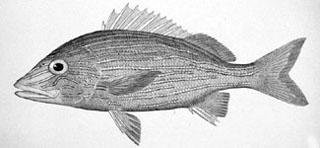
Hæmulon elegans, NOAA, Drawing by H. L. Todd
One of my favorite essays describes Louis Agassiz's approach to teaching. Agassiz was the first to present a scientific case for an ice age (and a direct opponent to much of Darwin's work). In the Laboratory with Agassiz, also known as Look at Your Fish! by Samuel H. Scudder, tells the tale of Scudder's first encounter with his mentor Agassiz. And, of Scudder looking at his fish long and hard:
Half an hour passes—an hour—another hour; the fish began to look loathsome. ...
...At last a happy thought struck me—I would draw the fish; and now with surprise I began to discover new features in the creature. Just then the Professor returned.
"That is right," said he; "a pencil is one of the best of eyes. I am glad to notice, too, that you keep your specimen wet, and your bottle corked."
With these encouraging words, he added, "Well, what is it like?"
Scudder gave his reply in terms of what he had seen in his first hours with the fish. Agassiz listened and replied:
"You have not looked very carefully; why," he continued more earnestly, "you haven't even seen one of the most conspicuous features of the animal, which is a plainly before your eyes as the fish itself; look again, look again!" and he left me to my misery.
The tale continues, unearthing how Scudder learned to see more and more about the fish. And about looking.
And, if you went right past the first link above, it's a powerful example of how we blow by beauty in our rush from point A to point B. Here's virtuoso violinist Joshua Bell playing his Stradivarius in a Washington, DC Metro station and essentially being completely ignored:
Last month, New York University (NYU) unveiled its new state-of-the-art cogeneration (CoGen) power plant, designed to simultaneously provide heat and electricity to NYU's campus while helping to reduce its carbon footprint.
The upgrade was a central part of NYU's own climate action plan, spurred on by both the New York City Mayor Bloomberg's PlaNYC Climate Challenge, a directive for all city colleges and universities to cut carbon emissions voluntarily by 30% by 2017, and the American College and University President's Climate Commitment, a larger initiative across many institutions of higher learning to work towards climate neutrality.
The new plant is a marked improvement over NYU's previous oil-fired power plant. It is 90% efficient as opposed to a typical boiler plant, which is only 50-60% efficient, and it produces 13.4 megawatts of electricity, twice the output of the previous system. The new plant helps NYU reduce its overall greenhouse gas emissions by roughly 20%, cutting up to 5,000 metric tons of carbon per year.
Here is a great diagram of how it works. Briefly, natural gas powers two high-tech turbines, which are similar to jet engine turbines. The rotation from turbines generates electricity while the heat exhaust from the turbines is recovered and used to make steam. The steam is then shunted off for a variety of purposes. Some steam is used for heating and hot water, additional steam is used to drive another turbine for electricity generation, and in the summer, steam is shunted off to chiller to create cold water for air conditioning.
While the project was not cheap (price tag of $125 million), the university is expected to save $5-8 million in energy related costs per year.
This week's events in Egypt give us hope. I have hope for the end of repression both within Egypt and throughout the region. And I have regained some hope for the power of the people. No one knows where it will end, but these events clearly show that if enough people get excited enough and angry enough and connected enough, they can make a difference.
Sometimes I/we lose sight of that fact.
And, I for one, didn't see it coming.
Wow.
What lessons can take from the last three weeks with Egypt on the world stage? Well, I'm no political scientist, but that won't stop me from speculating. And I welcome corrections and clarifications.
It seemingly happened overnight, but it really didn't. The issues have been simmering for decades. Somehow, a tipping point was reached.
Communication technologies helped. Twitter, Facebook, youtube and Al Jazeera all clearly mattered and none of them alone were likely sufficient.
People got off their butts and into the streets. And onto Facebook, Twitter, Al Jazeera and such. Simmering anger alone doesn't do much. Communicating alone does a bit more.
Most of the participants didn't do a lot of planning. But my guess is that a few people did more than we have a sense of.